


Свържете се с
Адрес: 129 Jinxiu Avenue, Yaozhuang Town, Jiashan County, Jiaxing City, Zhejiang Province
Телефон: 0086 13957350809
Имейл: sales@moosoo.com.cn
Адрес: 129 Jinxiu Avenue, Yaozhuang Town, Jiashan County, Jiaxing City, Zhejiang Province
Телефон: 0086 13957350809
Имейл: sales@moosoo.com.cn
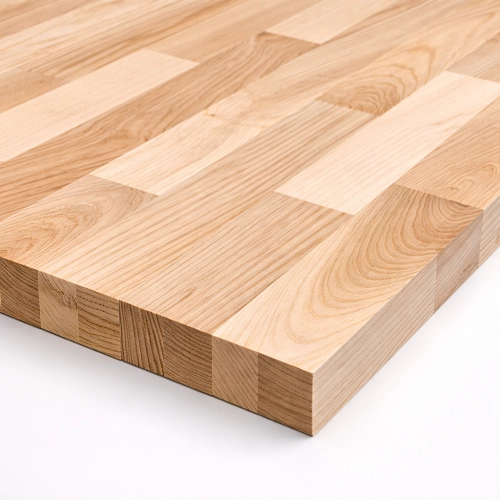
Finger‑jointed white elm hardwood panels are increasingly popular in fine woodworking, architectural millwork, furniture making, and interior design. They combine traditional hardwood beauty with modern engineered panel stability, making them a versatile material for a wide range of applications.
Finger‑jointed white elm hardwood panels are engineered wood products composed of multiple short pieces of white elm lumber joined end‑to‑end using interlocking “finger” profiles and high‑strength adhesives. These finger‑joined strips are then edge‑glued and pressed to form flat, dimensionally stable panels. The result is a solid hardwood panel with superior strength, reduced waste, and enhanced stability compared with single‑piece solid boards.
White elm refers to several species of elm with light‑colored heartwood and sapwood that ranges from pale straw to light tan. Elm is prized for its unique grain figure, moderate density, and interlocking grain pattern.
High‑quality white elm lumber is kiln‑dried to a stable moisture content (typically 6–8% for interior use). Boards are graded and defected (crooked grain, knots, splits) removed or trimmed.
Each board end is precision‑machined into interlocking “fingers” using specialized cutting heads. Typical finger lengths range from 3⁄4 to 1 1⁄2 inches depending on species and panel thickness.
High‑performance adhesives (e.g., PUR – polyurethane, or resorcinol/formaldehyde for exterior‑rated products) are applied to the fingers. Adhesives are chosen for strength, water resistance, and compatible open assembly time.
Finger‑joined strips are aligned and edge‑glued, then pressed under controlled pressure and temperature for curing. Panels are sanded flat and may be trimmed to final dimensions.
| Thickness | Typical Uses |
| 3/4″ (19 mm) | Furniture, cabinetry |
| 1″ (25 mm) | Table tops, benches |
| 1‑1/2″+ (38 mm+) | Structural millwork, high‑load interior elements |
Standard widths often fall between 24″ and 96″, with lengths up to 12 feet or more via continuous finger‑jointing. Profiles may also be supplied with eased or custom machine‑work.
Finger jointing minimizes the effects of seasonal moisture movement by interrupting long grain runs and reducing stress.
Due to mechanical interlock and glue surface area, finger joints often equal or exceed the strength of the base wood.
Properly dried and bonded panels are stable at 6–8% moisture content but should still acclimate to site conditions before installation. Finger‑jointed panels resist splitting and cracking due to grain breaks that interrupt contraction/expansion paths.
White elm’s interlocking grain and light color accept a range of finishes:
The end grain from the fingers takes finish differently than the long grain; brushing on sealers before final coats can equalize absorption.
Finger‑jointed panels provide solid wood aesthetics with improved stability for larger surfaces.
Easy to machine, sand, and finish.
Using thicker panels can provide structural character elements.
White elm’s acoustic qualities and visual appeal fit niche crafts.
| Benefit | Impact |
| Maximized lumber yield | Less waste, cost‑effective |
| Stability | Reduced movement over time |
| Strength | Solid, reliable under load |
| Aesthetic continuity | Clean, continuous grain flow |
| Custom size availability | Flexibility for large projects |
Finger joints create small end‑grain lines across the panel.
Hardwood panels can be more expensive than plywood or MDF. White elm is less common than oak or maple, so sourcing may take planning.
Like all solid wood, edge grain will move with humidity. Designers may need to accommodate seasonal expansion.
| Panel Type | Stability | Strength | Appearance | Cost |
| Finger‑Jointed Elm | High | High | Premium hardwood | Medium–High |
| Plywood | Very High | Good | Veneer surface | Low–Medium |
| MDF | High | Moderate | Smooth paint surface | Low |
| Veneered Panels | Varies | Depends core | Hardwood veneer | Medium |
Finger‑jointed panels bridge the gap between pure solid wood and engineered substrates, offering a balance of appearance and performance.
Allow panels to stabilize in the work environment (48–72 hrs) before machining or installation.
Seal end grain first to prevent blotchiness; apply multiple thin coats for durability.
Finger‑jointing improves yield from lumber by enabling the use of shorter pieces that might otherwise be waste. Responsible sourcing (FSC, SFI) ensures ecological forestry practices. Engineered panels generally reduce waste compared to selecting large clear boards.
Finger‑jointed white elm hardwood panels offer a compelling choice for craftspeople, designers, and architects seeking the beauty of solid hardwood combined with enhanced stability and efficient use of materials. Their mechanical strength, surface quality, and versatility make them suitable for fine furniture, architectural millwork, and many custom woodwork applications. Understanding their properties, advantages, and working characteristics ensures successful outcomes in both creative and functional projects.